Many drivers treat their vehicle’s transmission fluid as a “lifetime” component, a belief that often leads to catastrophic mechanical failure. While modern marketing materials might suggest that factory-sealed units require no intervention, seasoned mechanics know that heat, friction, and metallic debris eventually compromise the fluid’s chemical integrity. Ignoring this maintenance schedule is a gamble with your wallet that rarely pays off in the long run. When the fluid degrades, it loses its ability to lubricate delicate internal gears, leading to an exponential increase in wear that goes unnoticed until you feel that first ominous shudder during a shift.
The financial reality of a full transmission rebuild is staggering, often costing between $3,000 and $5,000 for a standard mid-size vehicle. Preventative maintenance is significantly cheaper than total replacement. By spending a few hundred dollars on a fluid flush every 60,000 miles, you effectively protect the most expensive mechanical system in your car. Postponing this service is the primary reason many cars reach the scrap yard prematurely. Most owners fail to realize that transmission fluid acts as both a lubricant and a hydraulic medium, meaning that even a slight reduction in viscosity can cause the entire system to run hotter than its design parameters allow.
Understanding the Hidden Friction Within Your Drivetrain
Inside the complex housing of your transmission, hundreds of tiny, precisely machined parts interact under extreme pressure and heat. The fluid’s primary role is to carry heat away from these components while keeping the friction plates engaged properly. When the fluid becomes contaminated with microscopic metal shavings and clutch material, it essentially transforms into a grinding paste. This abrasive mixture acts like sandpaper on your transmission’s internal seals and bearings. If you allow this to continue, you are essentially accelerating the mechanical demise of the unit with every mile you drive.
You might assume that your driving habits are gentle enough to bypass these requirements, but city driving is actually the most taxing environment for a transmission. Stop-and-go traffic creates constant heat spikes that degrade the fluid faster than long-distance highway driving. If you live in an area with heavy congestion or hilly terrain, your transmission is working significantly harder than you imagine. Failing to account for these driving conditions is a common error that voids many long-term vehicle health prospects. Professional technicians often suggest cutting the manufacturer’s recommended interval in half if the vehicle is used for towing, heavy commuting, or high-temperature climates.
The Financial Ripple Effect of Neglect
Calculating the total cost of ownership involves more than just fuel and insurance; it requires an honest look at long-term depreciation. A vehicle with a documented history of meticulous fluid changes holds a higher resale value because savvy buyers recognize the rarity of such care. Conversely, a transmission that has been neglected will eventually exhibit harsh shifting, gear slipping, or delayed engagement. These symptoms are not just nuisances; they are loud warnings that a massive repair bill is imminent. Once these signs appear, simple fluid services are often no longer sufficient to save the unit.
Consider the trade-off: Investing in high-quality synthetic fluid now saves you thousands in future labor costs. When you compare the price of a $250 fluid exchange to the cost of a transmission overhaul, the math heavily favors the proactive approach. Many owners justify skipping the service to save a small amount of cash, only to face a total system failure that dwarfs their initial savings. Furthermore, a transmission failure often occurs at the most inconvenient moment, potentially leaving you stranded and subject to expensive towing fees. The hidden costs of mechanical neglect inevitably become the most expensive line items on your annual car budget.
Decoding Signs That Your Fluid Is Failing
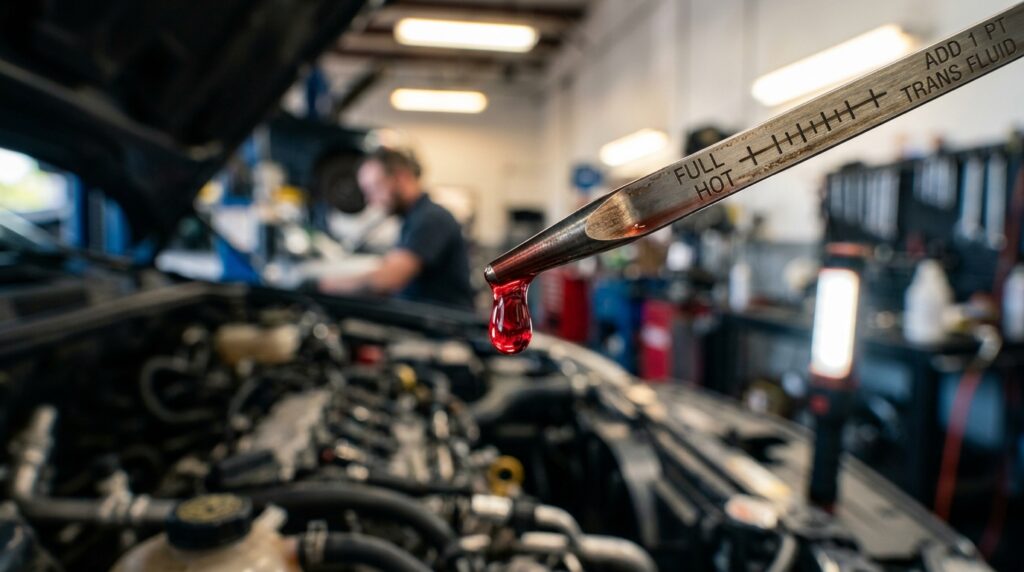
It is vital to pay attention to your car’s subtle behavioral changes before they escalate. One of the most effective ways to gauge the state of your fluid is by performing a quick visual and olfactory check. If the fluid has turned from a bright, translucent red to a dark brown or black color, it has already lost its effectiveness and likely contains significant contaminants. A burnt, acrid smell emanating from the dipstick area is a clear indicator that the fluid has been thermally degraded beyond repair. Do not ignore these sensory warnings, as they are often the last chance to avoid a major mechanical disaster.
Apart from the fluid’s condition, watch for inconsistent shift timing or a noticeable lag when switching from Park to Drive. If the vehicle feels like it is “searching” for the right gear, the valve body may be struggling due to thick, dirty fluid. Addressing these early symptoms often prevents the need for a total component replacement. Sometimes, a simple service can clear minor obstructions in the valve body, potentially extending the life of the transmission by tens of thousands of miles. Ignoring these early warnings is a mistake that frequently leads to a complete breakdown on the side of the road.
Making the Informed Decision for Your Vehicle
Ultimately, the choice comes down to your priorities regarding vehicle longevity and financial prudence. While it is tempting to follow the absolute minimum maintenance schedule outlined in your owner’s manual, these documents are often written with fleet-lease expectations in mind rather than personal long-term ownership. If you intend to keep your car for more than 100,000 miles, you should treat transmission fluid replacement as a mandatory routine. Taking charge of your car’s maintenance is the single best way to ensure it remains a reliable asset for years to come.
The peace of mind that comes with a well-maintained drivetrain is worth far more than the nominal cost of the service. Smart maintenance habits prevent costly breakdowns and keep your vehicle running smoothly. Don’t wait for a warning light or a mechanical failure to act. By being proactive, diligent, and informed, you protect your investment from the avoidable damage caused by neglected fluid. Your future self will certainly thank you when your car continues to shift perfectly long after the competition has retired to the junkyard.
Used only with old Urchin versions of Google Analytics and not with GA.js. Was used to distinguish between new sessions and visits at the end of a session.
End of session (browser)
__utmz
Contains information about the traffic source or campaign that directed user to the website. The cookie is set when the GA.js javascript is loaded and updated when data is sent to the Google Anaytics server
6 months after last activity
__utmv
Contains custom information set by the web developer via the _setCustomVar method in Google Analytics. This cookie is updated every time new data is sent to the Google Analytics server.
2 years after last activity
__utmx
Used to determine whether a user is included in an A / B or Multivariate test.
18 months
_ga
ID used to identify users
2 years
_gali
Used by Google Analytics to determine which links on a page are being clicked
30 seconds
_ga_
ID used to identify users
2 years
_gid
ID used to identify users for 24 hours after last activity
24 hours
_gat
Used to monitor number of Google Analytics server requests when using Google Tag Manager
1 minute
_gac_
Contains information related to marketing campaigns of the user. These are shared with Google AdWords / Google Ads when the Google Ads and Google Analytics accounts are linked together.
90 days
__utma
ID used to identify users and sessions
2 years after last activity
__utmt
Used to monitor number of Google Analytics server requests
10 minutes
__utmb
Used to distinguish new sessions and visits. This cookie is set when the GA.js javascript library is loaded and there is no existing __utmb cookie. The cookie is updated every time data is sent to the Google Analytics server.