Rent goes up and you notice immediately. It hits hard, it forces a reaction, and you adjust your budget around it.
Subscriptions don’t work like that. They move silently, spread across your bank statement, and rarely trigger the same level of attention. But when you actually total them, the impact can rival or even exceed major fixed expenses over time.
Small charges feel harmless until they stack
A $9.99 streaming service doesn’t feel like a problem. Neither does a $12 fitness app or a $5 cloud storage plan.
Individually, these costs are easy to justify. But most people aren’t paying for just one or two. It’s usually 6 to 12 active subscriptions running at the same time, often without full awareness.
Let’s run a realistic scenario. If you have:
$15 for streaming
$10 for music
$12 for software
$8 for cloud storage
$20 for a gym app or platform
You’re already at $65 per month, and that’s conservative. Many people sit closer to $100 to $150 monthly without noticing.
Over a year, that becomes $1,200 to $1,800, which is equivalent to a significant rent increase in many cities.
The biggest mistake is not tracking renewal cycles
Most subscription losses don’t come from services you actively use. They come from the ones you forgot.
Free trials convert into paid plans. Annual renewals hit without warning. Old tools you needed once stay active for months.
The key issue is timing. Subscriptions are designed to renew when you’re not paying attention, often at moments when you’re busy or distracted.
Missing just two or three cancellations can cost $200 to $500 per year on services you barely remember signing up for.
This isn’t accidental. It’s part of how subscription models are built.
Convenience creates financial blind spots
Subscriptions are successful because they remove friction.
You don’t feel the purchase. There’s no checkout decision each month. Everything happens automatically.
That convenience creates a dangerous effect. You stop evaluating whether the service is still worth paying for.
For example, you might keep a streaming platform for one show. Once you finish it, you forget to cancel. Three months later, you’ve paid $45 for something you’re no longer using.
The same happens with productivity tools, design software, and even financial apps.
The easier it is to subscribe, the harder it becomes to stop paying.
Annual plans can trick you into overspending
Annual subscriptions look like a smart move. Pay upfront, save 20% or 30%, and avoid monthly charges.
But that only works if you actually use the service consistently.
If you pay $120 for a yearly plan and stop using it after 3 months, your real monthly cost becomes $40 instead of $10.
That’s the hidden risk. Discounts only save money when usage is consistent over time.
Otherwise, you’re just prepaying for something you won’t fully use.
A simple audit can recover real money quickly
Most people don’t need complex budgeting tools to fix this. They need visibility.
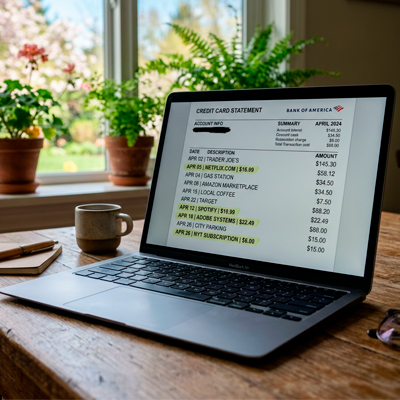
Start by checking your last two bank statements. List every recurring charge. No exceptions.
You’ll likely find:
Duplicate services serving the same purpose
Old subscriptions tied to past projects
Platforms you use once or twice a month
Cutting just 3 to 5 unused subscriptions can free up $30 to $80 monthly.
That’s $360 to $960 per year, recovered without changing your lifestyle.
The key isn’t extreme discipline. It’s awareness.
Subscriptions change how you perceive affordability
Here’s a less obvious insight.
Subscriptions make expensive things feel accessible. Instead of paying $300 upfront, you pay $15 per month. It feels manageable.
But over time, this shifts your spending behavior. You become more comfortable stacking commitments.
Before you realize it, you’re managing 10 to 15 recurring payments, each justified individually, but heavy when combined.
This changes how you evaluate money. You stop thinking in totals and start thinking in fragments.
That shift is subtle, but it’s where most overspending begins.
When subscriptions actually make sense
Not all subscriptions are bad. Many provide real value when used properly.
They make sense when:
You use the service frequently
It replaces a more expensive alternative
It directly improves your income or productivity
For example, a $20 tool that helps you generate $200 is clearly worth it.
The problem is that most subscriptions don’t meet that standard. They sit in a gray area of “maybe useful” without delivering consistent value.
That’s where the money leak happens.
Subscriptions don’t feel like big financial decisions. That’s exactly why they work so well.
No single charge forces you to stop and think. But together, they reshape your budget quietly, month after month.
The real risk isn’t one expensive mistake. It’s a collection of small ones that never get reviewed.
And once they stack high enough, you’re not just paying for services anymore. You’re paying for habits you stopped questioning.