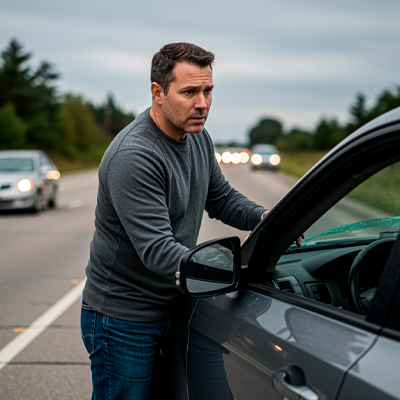
If you look at the image above, you’ll notice something subtle but important: a driver focused on the road, surrounded by a modern vehicle interior. That scene reflects how insurers see you—not just as a person, but as a combination of behavior, environment, and machine.
Car insurance isn’t a fixed bill. It’s a dynamic price that shifts based on risk signals, many of which drivers never think about. Two people with nearly identical cars can receive quotes that differ by hundreds—or even thousands—of dollars per year.
Understanding how insurers actually calculate that risk is what separates someone who overpays from someone who stays in control.
What Insurers Are Really Measuring (It’s Not Just Your Record)
Most drivers assume their premium is based on accidents and tickets. That’s only part of the equation.
Behind every quote, insurers run models that estimate how likely you are to cost them money in the future. That includes:
Frequency risk → how often you might file a claim
Severity risk → how expensive that claim might be
Exposure risk → how often you’re in situations where accidents happen
A driver who commutes 60 miles a day in heavy traffic is statistically more expensive to insure than someone who drives 10 miles in a quiet area—even with the same clean record.
The Car You Drive Sends Strong Signals to Insurers
The vehicle itself can quietly push your premium up or down.
It’s not just about price—it’s about repair complexity and parts cost.
A newer SUV with sensors, cameras, and driver assistance features may look safer, but it also comes with:
Higher repair costs after minor collisions
Specialized calibration for sensors
More expensive replacement parts
For example, replacing a bumper on a basic sedan might cost around $600–$900. On a newer SUV with sensors, that same repair can exceed $2,000–$3,000 after recalibration.
That’s why “safer” cars don’t always mean cheaper insurance.
Where You Live Can Change Your Premium Overnight
Location is one of the most underestimated factors.
Insurers analyze data like:
Local accident rates
Theft frequency
Traffic density
Weather-related claims
Moving just a few miles—from a suburban zone to a dense urban area—can increase your premium by 20% to 40%, even if nothing else changes.
In large cities, the issue isn’t just accidents—it’s probability. More cars, more congestion, more chances for something to go wrong.
Driving Behavior Is Now Tracked More Closely Than Ever
The driver in the image isn’t just holding the wheel—today, many vehicles are also collecting data.
With telematics programs and app-based tracking, insurers can monitor:
Braking patterns
Acceleration habits
Time of day you drive
Phone usage while driving
This has created a new pricing layer: behavior-based insurance.
A driver who avoids hard braking and late-night driving may qualify for discounts of 10% to 30%, even without a long driving history.
On the other hand, aggressive driving patterns can increase your premium—even without accidents.
Small Decisions That Quietly Increase Your Insurance Cost
Most drivers don’t realize how small choices affect pricing over time.
Here are a few common ones:
Choosing a low deductible → lowers upfront risk but increases monthly cost
Skipping coverage review each year → missing better pricing options
Adding unnecessary coverage → paying for protection you don’t need
Ignoring credit score impact (in some states) → higher premiums without clear reason
These aren’t major mistakes individually—but over time, they add up.
A difference of $50 per month becomes $3,000 over five years.
A Real Scenario: Same Car, Completely Different Price
Let’s compare two drivers with nearly identical vehicles:
Driver A:
Clean driving record
Lives in a suburban area
Drives mostly during the day
Low annual mileage
Driver B:
One prior claim
Lives in a dense city
Drives at night regularly
Higher mileage
Even with the same car and coverage, Driver B could easily pay $800–$1,500 more per year.
This isn’t about fairness—it’s about risk exposure.
What Actually Lowers Your Insurance Cost
If you want to reduce your premium, you don’t need tricks—you need strategy.
Focus on changes that affect risk perception:
Increase your deductible (if financially safe)
Bundle policies (auto + home or renters)
Drive fewer miles when possible
Use telematics programs if you drive safely
Requote your policy every 6–12 months
Many drivers stay with the same insurer for years without checking rates. That alone can cost hundreds per year.
Why Ignoring This Costs More Than You Expect
The biggest mistake is treating insurance as a fixed expense.
It’s not.
It’s a flexible cost that reacts to your behavior, environment, and decisions.
If you ignore it:
You overpay without noticing
You miss better coverage options
You stay locked into outdated pricing
But if you understand how it works, you can actively control it.
Final Thoughts
Car insurance isn’t just about protecting your vehicle—it’s about managing risk in a system that constantly evaluates you.
The driver in the image represents more than someone on the road. It represents a profile—a combination of habits, location, and decisions that directly influence cost.
If you want better rates, focus on what insurers actually measure:
How you drive
Where you drive
What you drive
How often you review your policy
Once you understand that, insurance stops being a mystery—and becomes something you can optimize instead of accept.