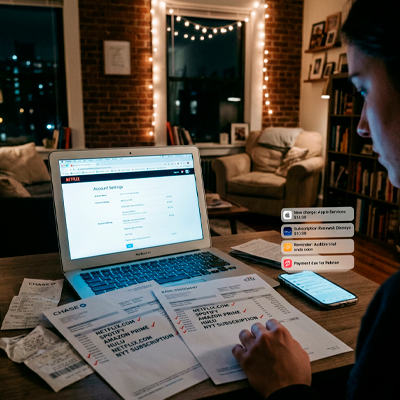
Most Americans no longer feel shocked by a $9.99 charge, a $14 subscription, or a $27 financing plan. Small recurring payments became so normal that millions of consumers barely notice how much money leaves their accounts every month until their bank balance suddenly feels tight.
What changed over the last few years is not only inflation or higher living costs. A major shift happened in the way companies sell products. Instead of asking people to spend $800 upfront, businesses increasingly divide purchases into tiny monthly commitments that feel psychologically harmless.
That change quietly transformed consumer behavior across the United States.
A streaming service here. A buy-now-pay-later installment there. Cloud storage. Premium delivery memberships. App subscriptions. Financing for phones, mattresses, gym equipment, furniture, and even fast food orders in some cases.
Individually, many of these charges feel manageable. Combined together, they often create a surprisingly heavy financial burden that consumers underestimate for months or even years.
Many households earning decent salaries are now struggling with cash flow despite technically making more money than they did five years ago.
Part of the reason comes from how modern spending hides itself inside automation.
Consumers rarely “feel” the purchase after the first transaction.
The money simply disappears quietly every month.
Small Charges Became More Dangerous Than Large Purchases
Large purchases used to trigger hesitation naturally. Spending $1,200 at once forces people to pause, compare options, and evaluate consequences carefully. Smaller recurring payments bypass that emotional resistance almost entirely.
That psychological difference changed how people consume products online.
A person may reject buying a $600 laptop upgrade immediately, but the same person may accept:
$18 monthly software
$11 streaming platform
$24 fitness app
$39 premium membership
$17 cloud storage
$42 phone protection plan
Within a few months, those recurring costs can easily exceed the original large purchase they tried to avoid.
Many consumers underestimate recurring expenses because the charges never arrive all at once. The brain processes smaller numbers differently, especially when payments happen automatically without friction.
Companies understand this extremely well.
Subscription-based business models exploded precisely because recurring billing creates higher long-term spending while feeling less painful emotionally.
A surprising number of Americans now maintain 15 to 30 active subscriptions without knowing the exact monthly total.
That becomes especially dangerous when salaries stagnate while recurring costs continue expanding silently in the background.
Buy Now Pay Later Created a New Kind of Financial Pressure
Services like installment-based shopping became incredibly popular because they reduced the emotional discomfort of expensive purchases. Consumers suddenly gained access to products that previously felt financially out of reach.
Furniture, electronics, clothing, travel packages, gaming consoles, and even groceries started appearing behind tiny installment buttons.
At first glance, that sounds convenient.
Sometimes it genuinely is.
But the long-term consequences became harder to ignore once multiple payment plans started overlapping simultaneously.
A consumer may only owe $42 here, $31 there, and $18 elsewhere, yet still carry hundreds of dollars in fragmented monthly obligations.
The problem becomes worse because installment systems psychologically disconnect purchases from reality.
A person financing:
new AirPods
a smartwatch
weekend travel
designer sneakers
a gaming monitor
may not emotionally process those purchases as major spending events anymore.
They simply become “another monthly payment.”
That subtle mental shift changes spending behavior dramatically over time.
Many younger consumers now organize their entire financial lives around monthly affordability instead of total ownership cost.
That distinction matters far more than people realize.
Paying $45 per month for 24 months feels manageable emotionally. Paying $1,080 upfront feels serious.
Even though mathematically they may represent nearly the same expense.
Subscription Fatigue Started Affecting Middle Income Families
A few years ago, subscription overload mostly affected entertainment spending. Today, subscriptions expanded into almost every category imaginable.
Consumers now encounter recurring billing for:
meal delivery
productivity apps
AI tools
cloud gaming
security systems
online learning
grocery delivery
pet products
digital newspapers
vehicle features
fitness programs
Some automakers even experimented with charging monthly fees for physical features already installed inside vehicles.
That idea frustrated many consumers because ownership itself started feeling temporary.
People increasingly feel like they are renting access to modern life instead of fully owning the products they buy.
Middle-income households became especially vulnerable to this shift because many subscriptions appear individually affordable.
A family earning $90,000 to $140,000 annually may still feel financially stressed after combining:
childcare costs
insurance increases
streaming bundles
financed electronics
rising grocery expenses
recurring app payments
car loans
subscription memberships
The issue is rarely one catastrophic expense.
Instead, pressure builds through dozens of small financial leaks happening simultaneously.
That accumulation effect became one of the most underestimated consumer finance problems in America.
Digital Convenience Often Hides Real Financial Consequences
Modern spending became frictionless by design.
Consumers no longer need to physically hand over cash, swipe cards repeatedly, or even think carefully before making many purchases. One-click checkout systems removed most pauses that previously helped people reconsider spending decisions.
That convenience accelerated impulsive purchasing dramatically.
A consumer scrolling social media late at night can finance products within seconds without fully evaluating necessity, long-term value, or future financial pressure.
The emotional gap between desire and payment almost disappeared.
That matters because friction historically protected people from impulsive financial behavior.
The easier spending becomes, the harder it becomes to recognize unhealthy consumption patterns early.
Many consumers only realize the damage after reviewing:
credit card balances
subscription renewals
overdraft fees
shrinking savings
growing monthly obligations
By then, reversing the pattern becomes harder because the recurring costs already integrated into daily routines.
Canceling subscriptions often feels emotionally uncomfortable once people depend on the convenience attached to them.
Meal delivery saves time.
Streaming reduces boredom.
Cloud storage feels necessary.
Premium apps improve workflow.
Even unnecessary services can start feeling emotionally essential after long enough.
A Growing Number of Consumers Started Returning to Simpler Spending Habits
Interestingly, a countertrend has started appearing among younger professionals and financially exhausted households.
Some consumers are intentionally reducing recurring expenses after realizing how aggressively automated spending expanded over the last few years.
Instead of focusing only on salary increases, many people started paying closer attention to:
subscription audits
recurring payment trackers
cash-only budgeting
debt reduction
minimal spending routines
intentional ownership
Financial creators online also helped expose how dangerous “tiny monthly payments” can become when stacked together endlessly.
Videos showing people discovering $400 to $900 per month in forgotten subscriptions became increasingly common across social platforms.
That created a broader cultural conversation around digital spending awareness.
Consumers are slowly realizing that financial stress often comes from accumulation, not necessarily from one disastrous purchase.
This shift does not mean subscriptions or financing are inherently bad.
Many services provide genuine value.
The real problem starts when convenience removes awareness completely.
A well-managed subscription can improve productivity or quality of life. Ten poorly monitored recurring payments can quietly destroy monthly financial flexibility.
That distinction became increasingly important as companies continue optimizing systems designed to maximize recurring consumer spending.
Financial Awareness Is Becoming More Valuable Than Income Alone
One of the biggest misconceptions in modern consumer culture is the belief that higher income automatically solves spending problems.
In reality, many households earning strong salaries still struggle because lifestyle automation expanded faster than financial awareness.
People adapt to recurring payments surprisingly quickly.
A consumer who once considered $200 monthly discretionary spending excessive may gradually normalize $700 or $900 in recurring expenses without noticing the transition clearly.
That normalization process happens slowly enough to feel invisible.
Financial stability today increasingly depends on awareness, not just earnings.
Consumers who regularly review subscriptions, monitor installment plans, and question convenience-based purchases often maintain stronger financial flexibility than people earning significantly more money.
That difference became one of the defining patterns of modern consumer behavior.
And as businesses continue shifting toward subscription-driven models, the ability to recognize hidden recurring costs may become one of the most important financial skills consumers develop over the next decade.
Used only with old Urchin versions of Google Analytics and not with GA.js. Was used to distinguish between new sessions and visits at the end of a session.
End of session (browser)
__utmz
Contains information about the traffic source or campaign that directed user to the website. The cookie is set when the GA.js javascript is loaded and updated when data is sent to the Google Anaytics server
6 months after last activity
__utmv
Contains custom information set by the web developer via the _setCustomVar method in Google Analytics. This cookie is updated every time new data is sent to the Google Analytics server.
2 years after last activity
__utmx
Used to determine whether a user is included in an A / B or Multivariate test.
18 months
_ga
ID used to identify users
2 years
_gali
Used by Google Analytics to determine which links on a page are being clicked
30 seconds
_ga_
ID used to identify users
2 years
_gid
ID used to identify users for 24 hours after last activity
24 hours
_gat
Used to monitor number of Google Analytics server requests when using Google Tag Manager
1 minute
_gac_
Contains information related to marketing campaigns of the user. These are shared with Google AdWords / Google Ads when the Google Ads and Google Analytics accounts are linked together.
90 days
__utma
ID used to identify users and sessions
2 years after last activity
__utmt
Used to monitor number of Google Analytics server requests
10 minutes
__utmb
Used to distinguish new sessions and visits. This cookie is set when the GA.js javascript library is loaded and there is no existing __utmb cookie. The cookie is updated every time data is sent to the Google Analytics server.